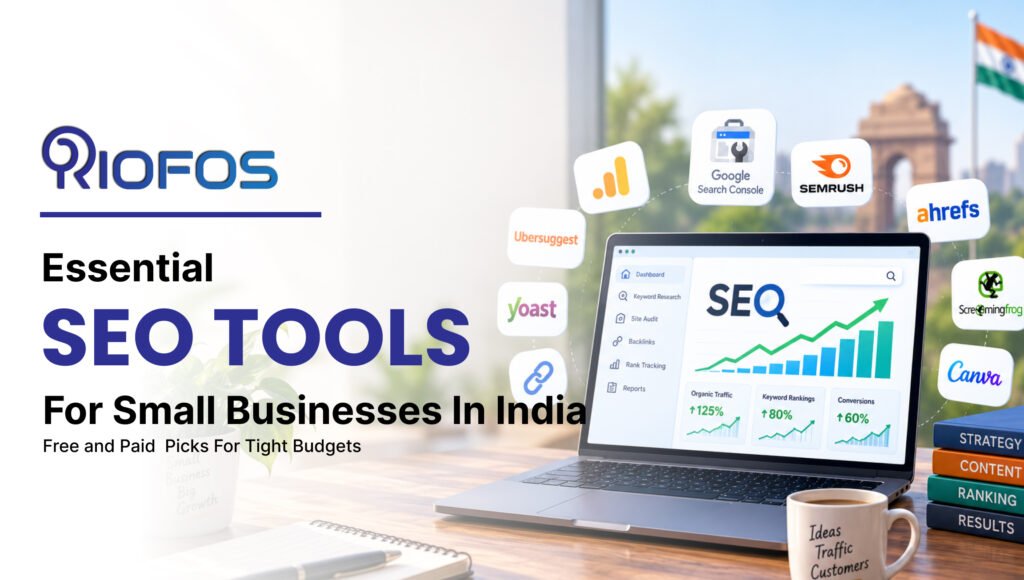
Many small business owners in India open the Semrush or Ahrefs pricing page exactly once, then close the tab and assume SEO is too expensive to bother with. That reaction is understandable, but it leaves a lot of organic visibility on the table. A lean, well-chosen set of SEO tools for small businesses can handle keyword research, site audits, backlink monitoring, and rank tracking at a fraction of the cost of an enterprise subscription. Some tasks cost nothing at all.
At Riofos Technologies, we work with small businesses across India on SEO campaigns, and the first question we always get is: which tools should I actually be using? The answer is never “subscribe to everything.” It is about picking the right tool for each specific job and knowing when a free option is genuinely sufficient. This guide does exactly that. You will leave with a focused toolkit, a weekly workflow you can realistically follow, and a clear sense of when it makes sense to upgrade.
What a practical SEO toolkit for small businesses actually looks like
The goal is not to find one platform that does everything. It is to cover five core functions with the lightest possible tool for each: keyword research, on-page audits, backlink monitoring, rank tracking, and reporting. This lean stack philosophy prevents you from paying for features you will never use and avoids the trap of tool overload, where you have five subscriptions and use none of them consistently.
The free Google suite as your starting point
Before spending a single rupee on third-party tools, set up the four free Google utilities that form a solid baseline for any small business. Google Search Console shows you which queries drive traffic to your site, flags indexing problems, and surfaces Core Web Vitals issues. Google Analytics 4 tracks how visitors behave once they land on your pages. Google Keyword Planner gives you search volume estimates and keyword ideas, while Google Trends shows how demand shifts seasonally and by region across India. These four tools alone are enough to run a meaningful SEO operation in the early stages.
Matching tools to your business stage
A simple three-tier model helps you decide what to add and when. If you are just getting started, stick to free tools only: the Google suite plus Ahrefs Webmaster Tools. If you are actively growing and publishing content regularly, add one freemium tool for technical audits or rank checks. If you are scaling and consistently hitting free-tier limits, that is the signal to bring in one affordable paid tool per key function, such as SE Ranking for rank tracking or Screaming Frog’s paid licence for larger site crawls. This progression prevents you from overbuying tools before you have the workflow to use them.
What “lightweight” means for SEO tools small businesses rely on
Lightweight SEO tools are browser-based or low-overhead desktop applications that return useful data without a complex setup or steep learning curve. The trade-off is real, though: free and freemium tools carry hard limits. Screaming Frog’s free version crawls a maximum of 500 URLs per audit. Search Console data is typically two to three days behind real time. Free plans on most keyword tools cap you at a limited number of daily searches, for instance, tools such as Ubersuggest restrict free users to a small fixed daily allowance. These limits are not dealbreakers for small sites; they are simply the point at which you know you have outgrown the free tier.
Keyword research and on-page SEO checker tasks without the expensive subscription
These are the two tasks small business owners need to handle most often, and both are very manageable without a full-suite paid subscription. The key is knowing which free and low-cost tools are genuinely reliable for each job.
Using Google Keyword Planner and Trends together
Start in Keyword Planner to find approximate search volume and cost-per-click data for your core terms. The volumes appear as ranges unless you have an active Google Ads campaign running, so treat them as directional rather than precise. Cross-reference any promising terms in Google Trends, filtering by India and your relevant region. For example, a jewellery retailer in Surat could check demand for “gold earrings online” and immediately see whether that search interest peaks around Diwali or Akha Teej, which directly informs when to publish or update content targeting that term.
Screaming Frog free tier for technical spot-checks
The free desktop version of Screaming Frog crawls up to 500 URLs, which is suitable for many small business websites and for targeted spot-checks. Run three checks before doing anything else: look for pages with missing or duplicate title tags, identify any redirect chains longer than two hops, and flag broken internal links that might be causing crawl waste. In our experience auditing small business sites, these issues appear with striking frequency, and fixing them costs nothing but time.
No-signup tools for instant page-level checks
For quick one-off checks, several tools return useful on-page audit results without requiring an account at all. SEOmator, SiteGuru, and the Semrush free tools page all offer no-signup access to basic diagnostics: metadata analysis, page speed signals, and heading structure checks. These are useful when you have updated a key page and want a fast sanity check before it goes live, without committing to a login or a paid plan.
Backlink monitoring and rank tracking: SEO tools small businesses can actually afford
Backlinks and rankings are where small businesses feel most locked out, because the most comprehensive data lives behind expensive platform subscriptions. The practical reality is that you do not need the full database. You need to know whether your own site is gaining or losing links, and whether your target keywords are moving in the right direction.
Ahrefs Webmaster Tools for backlink analysis
Verifying your site in Ahrefs Webmaster Tools is one of the highest-value free actions you can take. It gives you access to your own backlink profile and a basic site audit, with up to 5,000 crawl credits per month for each verified project. From there, monitor new referring domains as they appear and watch for sudden drops in your link profile that might signal a problem. You can also find broken backlinks pointing to pages that no longer exist. You do not need the full Ahrefs paid plan for any of these tasks if your primary concern is your own site rather than competitor research.
SE Ranking and KeySearch as affordable rank trackers
In our experience working with small business clients, SE Ranking is the most practical lightweight paid option for reliable rank tracking and site audits. Its entry-level pricing is considerably lower than what Ahrefs or Semrush charge at their starting tiers, and the interface is straightforward enough that you do not need to spend hours learning it. SE Ranking offers a 14-day free trial, so you can assess whether it suits your workflow before committing. KeySearch is a lower-cost alternative that bundles keyword research, rank tracking, and basic competitor checks into a single plan, making it a practical choice for solo operators or very small teams who want one tool to cover multiple jobs without complexity.
What the free-tier limits mean in practice
Be clear-eyed about the limits of free-tier tools. Daily query caps on free keyword tools will stop your research mid-task if you are working through a large list. Search Console data lags by two to three days, which matters if you are trying to track the immediate impact of a page update. Free plans on most backlink and rank tracking tools provide little to no competitor data. None of these limitations are a crisis; they are simply signals. When you find yourself hitting the same limit repeatedly, that is when you upgrade, not before.
Local SEO and performance reporting for Indian markets
For most small businesses in India, local search visibility is more valuable than broad national rankings. A bakery in Pune or a chartered accountant in Chennai both need to show up when nearby customers search with intent to buy. The tools and steps for local SEO are straightforward, and the reporting can be unified without expensive software.
Setting up Google Business Profile alongside your tools
A verified and fully optimised Google Business Profile is the single most impactful free action for any India-based business targeting local customers. Fill in every field: business category, service areas, operating hours, photos, and services. Read your GBP Insights data alongside Search Console to understand what local queries are driving impressions and clicks. Inconsistent NAP details across your website, GBP listing, and local directories remain one of the most common problems we see, and it costs nothing to fix beyond a systematic audit in a spreadsheet.
Connecting Search Console and GA4 for a unified traffic view
Link Search Console to GA4 through the Admin panel in Google Analytics, under Product Links. Once the connection is active, you can see organic landing pages, top queries, and user behaviour data in one place rather than toggling between two separate platforms. This connection is especially valuable for small teams that cannot afford a dedicated analytics hire: you can see which pages are earning search impressions, how many of those visits result in a conversion action, and where the gaps are in your organic funnel.
How a consolidated analytics dashboard cuts reporting time
Once your business is running campaigns across both organic and paid channels, the real problem is not the lack of data, it is the time spent moving between platforms to assemble a coherent picture. The Riofos Technologies marketing analytics dashboard is built to address exactly this. It brings together data from GA4, Google Search Console, Google Ads, and Meta Ads into a single view, so instead of cross-referencing four separate platforms every Monday morning, you can see your organic rankings, ad spend, conversions, and ROAS in one place. Platform APIs do introduce some data latency, but the dashboard significantly reduces the manual effort of weekly reporting. For businesses that have outgrown manual reporting but are not ready to hire a data analyst, it is a practical next step.
A practical weekly workflow and checklist for small teams
Knowing which tools to use is only half the job. The other half is building a routine you will actually follow. Small teams do not need a complex SEO strategy; they need a simple process that runs consistently.
A weekly SEO check routine that takes under an hour
The following schedule keeps your site health visible without consuming your working week. On Monday, spend 10 minutes in Search Console checking for crawl errors and reviewing your top-performing queries. On Wednesday, spend 10 minutes in GA4 reviewing organic traffic trends and bounce rates on your key landing pages. On Friday, run a Screaming Frog spot-check on any page you have recently updated or published. Monthly, pull a backlink report from Ahrefs Webmaster Tools and update your rank tracking data in SE Ranking or KeySearch to see whether your target keywords have moved.
The quick-reference checklist for keyword, audit and backlink tasks
Use the following checklist to keep your core SEO tasks on schedule:
- 1. Keyword review: Update your keyword list monthly using Keyword Planner and Trends, removing terms that have lost relevance and adding new seasonal targets.
- 2. On-page metadata: Check title tags and meta descriptions on your five highest-traffic pages every quarter for accuracy and keyword alignment.
- 3. Internal linking audit: Once a month, use Screaming Frog to check that new content is being linked from existing relevant pages.
- 4. Backlink monitoring: Review new and lost referring domains monthly in Ahrefs Webmaster Tools and follow up on any broken backlinks.
- 5. GBP update schedule: Aim to post an update, new photo, or offer to your Google Business Profile at least twice a month to keep the listing active and current.
When a managed SEO service saves more time than tools do
Tools are only as useful as the consistency and interpretation you bring to them. If you find yourself skipping the weekly checks three weeks in a row, it is a reliable sign that the tool-management overhead is competing with your actual business work. For businesses at that point, Riofos Technologies’ managed SEO and web development services are the practical alternative: the same results, without the tool juggling. Managed SEO in India typically runs from ₹15,000 to ₹30,000 per month for small businesses, a range that reflects current market rates among Indian digital agencies, and generally includes strategy, execution, and reporting. That is a meaningful cost, but it also replaces the time, subscriptions, and learning curve that self-managed tools require. Get in touch with our team if you want to understand what that looks like for your specific business.
The right tools, used consistently, are enough
A well-chosen mini SEO toolset does not have to cost a fortune, and for most small businesses in India, it does not need to. A combination of Google’s free suite for monitoring and research, Ahrefs Webmaster Tools for backlink checks, and one affordable rank tracker covers the majority of what any small business needs to improve its organic visibility. The three-tier model gives you a clear upgrade path: start free, add one freemium tool as you grow, then move to a paid tool only when you are consistently hitting free-tier limits.
The most common mistake we see is waiting for the perfect setup before running a first audit. Pick two tools from this article this week, run your first site check, and set up the weekly checklist. The businesses that rank consistently are not the ones with the most sophisticated toolset, they are the ones that show up and do the basics well, every single week. If you would prefer to skip the tool juggling entirely, our team at Riofos Technologies handles the full SEO workflow for you, from technical audits to content and reporting, so you can focus on running your business.